ClearWave Connect

ClearWave Connect Header

AI & Business Communications

Predictive Call Routing Explained How AI Connects Customers to the Right Person Instantly
AI & Business Communications

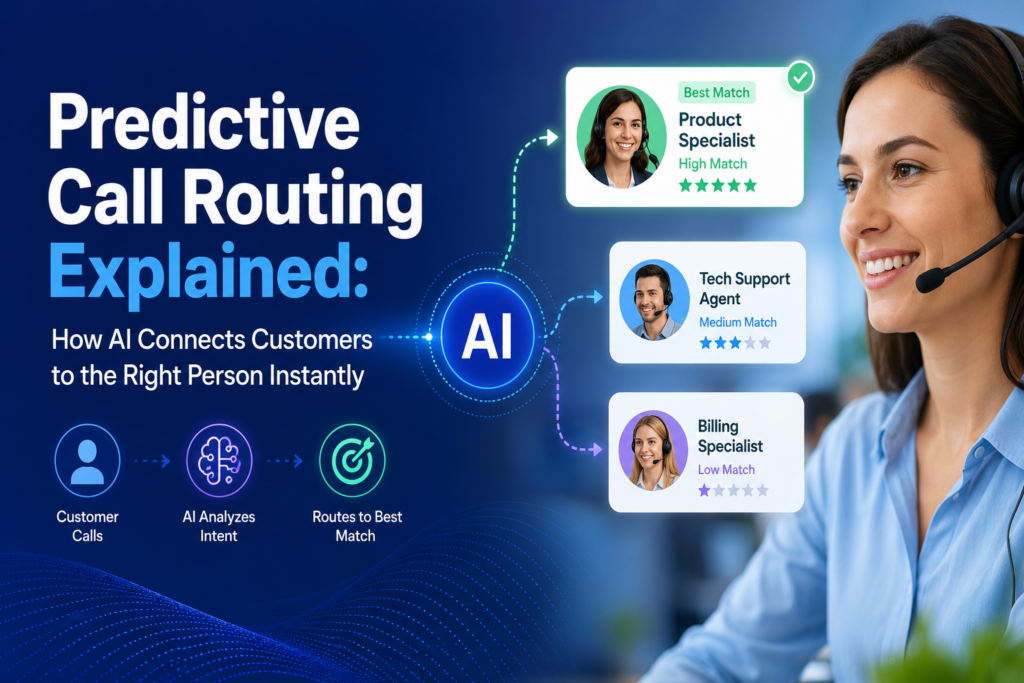
Predictive Call Routing Explained: How AI Connects Customers to the Right Person Instantly

Picture this: a customer calls your business during a busy Monday morning. They are not in the mood to listen to a long menu, repeat their issue three times, or wait while someone “finds the right department.” They need help now. Maybe it is a patient trying to confirm an appointment, a restaurant customer asking about a catering order, a retail shopper checking product availability, or a business client calling about an urgent service issue. In that moment, your phone system either creates confidence or frustration. That is where predictive call routing is changing the way modern businesses handle customer communication. Instead of sending every caller through the same basic phone tree, predictive call routing uses artificial intelligence, customer data, call history, intent recognition, and real-time business rules to connect each caller to the best available person, team, or automated resource. For businesses that depend on reliable phone service, fast response times, and smooth customer experiences, it is becoming one of the most practical uses of AI in business communications. What Is Predictive Call Routing? Predictive call routing is an AI-powered phone system feature that analyzes information about an incoming call and predicts the best destination for that caller. The goal is simple: get the customer to the right person faster. Traditional call routing usually follows fixed rules. For example, “Press 1 for sales, press 2 for support, press 3 for billing.” That may work for very simple organizations, but it often breaks down when customers do not know which option to choose, when departments overlap, or when agents have different skill levels. Predictive call routing is smarter. It can look at signals such as: With that information, the system can route a returning customer to the same representative, send a billing question directly to accounting, prioritize an urgent service issue, or move an after-hours caller to an AI phone assistant that can collect details and schedule a follow-up. How AI Makes Call Routing Faster and More Accurate AI improves call routing by recognizing patterns that a basic phone system cannot. Instead of relying only on keypad selections, modern systems can use natural language processing to understand what callers say in their own words. For example, a customer might say, “I was charged twice,” “I need help with my invoice,” or “There’s a problem with my bill.” A traditional menu may force that person to guess the right option. An AI-powered routing system can recognize that all three statements likely belong to billing support. AI can also learn from past interactions. If customers with a certain issue usually get resolved faster by a specific team, the system can begin routing similar calls there. If one agent has stronger results with technical troubleshooting while another is better at renewals or account questions, predictive routing can use that knowledge to improve future call outcomes. This is why AI in the contact center is not just about replacing people. In many cases, it is about helping customers reach the right people sooner. A 2025 McKinsey article on contact centers noted that voice remains a dominant live interaction channel and that AI can help connect systems in real time to create more intelligent service experiences. Why Businesses Are Moving Beyond Traditional IVR Menus Customers have become less patient with outdated phone menus. They expect fast answers, especially when they are calling from a mobile phone during a busy workday. Long hold times, confusing menu options, and repeated transfers can make a business feel disorganized even when the team behind the scenes is working hard. Research continues to show that wait time and difficulty reaching the right person are major pain points. The Qualtrics Contact Center Trends 2025 report found that consumers are least satisfied with the time they spend waiting, and that fewer than two in three issues are resolved on the first call. That matters because phone experience affects trust. When a customer gets routed correctly the first time, the conversation starts on a better note. The agent has more context, the customer feels heard, and the business has a better chance of resolving the issue quickly. The Business Benefits of Predictive Call Routing 1. Shorter Wait Times Predictive routing can reduce unnecessary transfers and queue time by sending callers directly to the best destination. When fewer people are stuck in the wrong queue, everyone moves faster. 2. Better First-Call Resolution First-call resolution is one of the most important customer service metrics. If the right person answers the first time, the customer is more likely to leave with a solved problem instead of a promise that someone will call back later. 3. Less Pressure on Staff Agents lose time when they answer calls that should have gone somewhere else. Predictive routing helps reduce that friction. A 2025 IDC InfoBrief commissioned by Talkdesk reported that many contact centers still depend heavily on live agents, while outdated IVR systems continue to create unresolved calls and customer frustration. 4. More Personalized Customer Service When the phone system recognizes a returning customer, open ticket, preferred department, or service history, the experience feels more personal. The caller does not have to start from zero every time. 5. Smarter After-Hours Call Handling Not every call happens during office hours. Predictive routing can work with an AI phone assistant to answer common questions, capture caller details, route emergencies, or schedule a callback. That means your business can stay responsive even when your team is unavailable. Predictive Call Routing Examples by Industry Healthcare Offices A patient calling about an appointment can be routed to scheduling, while a patient asking about a bill can go directly to the billing team. Urgent calls can be flagged and handled faster. Law Firms New client inquiries can go to intake, existing clients can reach their assigned legal team, and after-hours calls can be captured professionally instead of going to a basic voicemail box. Retail Businesses Customers can be routed based on store location, product category, order status, or return questions. Multi-location retailers can avoid
How AI-Powered Sentiment Analysis Is Changing How Businesses Handle Customer Calls
AI & Business Communications

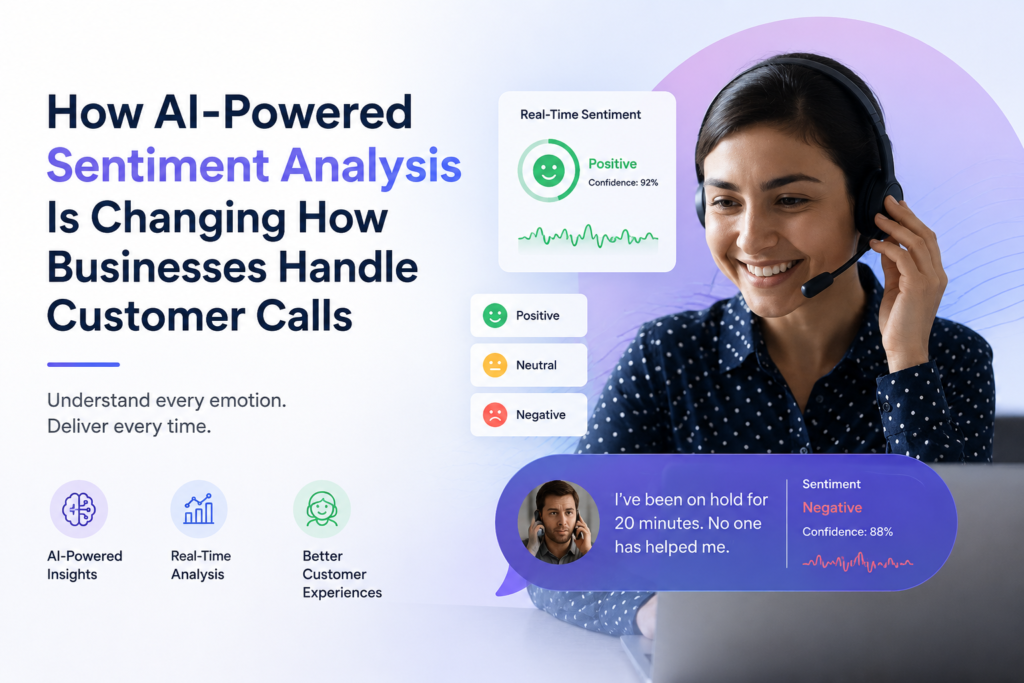
How AI-Powered Sentiment Analysis Is Changing How Businesses Handle Customer Calls

It starts with a customer who has already waited too long. Maybe their internet service went down during a busy lunch rush, their payment terminal stopped responding, or they have called twice and still have not reached the right person. By the time an employee answers, the customer’s words may sound polite, but the frustration is already there in the pauses, the tone, and the urgency behind every sentence. In the past, most businesses only discovered that a call went badly after the customer left a poor review, canceled service, or never came back. Today, AI-powered sentiment analysis is helping businesses recognize those moments while they are still happening. What Is AI-Powered Sentiment Analysis? AI-powered sentiment analysis uses artificial intelligence to evaluate the emotional tone behind customer interactions. In customer calls, this can include analyzing spoken words, call transcripts, tone of voice, pacing, repeated phrases, and other conversation signals. Modern contact center platforms are increasingly using natural language processing, machine learning, and predictive analytics to help businesses understand whether a customer sounds satisfied, confused, impatient, upset, or at risk of leaving. Microsoft’s Dynamics 365 documentation describes real-time sentiment as a way for representatives to instantly understand customer satisfaction levels during a conversation, helping them judge the seriousness of an issue and respond appropriately. For businesses, this means phone calls are no longer just conversations that disappear after someone hangs up. They become a source of real-time insight. Why Customer Calls Still Matter Even with email, chat, social media, and self-service portals, phone calls remain one of the most important channels for customer service. Customers often call when the issue is urgent, emotional, complex, or high-value. A 2025 Qualtrics contact center report found that contact center satisfaction directly impacts loyalty behaviors such as trust, recommendations, and future purchases. The same report noted that customers are still frustrated by wait times, unresolved issues, and difficulty reaching a real person. That is why AI sentiment analysis matters. It does not replace the human side of service. Instead, it gives employees and managers better visibility into what customers are experiencing in the moment. How Sentiment Analysis Changes the Way Businesses Handle Calls 1. It Helps Employees Respond With More Empathy A busy employee may be answering calls, checking orders, helping walk-in customers, and managing internal messages at the same time. In that environment, it is easy to miss subtle signs that a caller is becoming frustrated. AI sentiment analysis can flag a shift in tone or language so the employee knows when to slow down, clarify the issue, or offer reassurance. For example, if a caller moves from neutral to negative sentiment, the system can prompt the employee to acknowledge the problem more directly. Instead of saying, “Let me check on that,” the employee might say, “I understand why that is frustrating. Let me look into this right away and make sure we get you to the right answer.” That small change can completely alter the direction of a call. 2. It Improves Call Routing Traditional phone systems often route calls based on simple menus: press one for sales, press two for support, press three for billing. That works for basic needs, but it does not always account for urgency or emotion. AI-powered systems can help identify when a customer may need priority attention. If a caller sounds highly frustrated, mentions canceling, or repeats a serious issue, the system can route that call to a senior team member or supervisor. Sprinklr’s 2025 contact center AI trend analysis notes that predictive and AI-optimized routing is replacing static call flows, helping businesses improve first-contact resolution and reduce unnecessary transfers. For customers, that means fewer dead ends. For businesses, it means fewer escalations that arrive too late. 3. It Gives Managers Better Coaching Data In many businesses, call quality is reviewed manually. A manager may listen to a handful of recorded calls and try to identify patterns. The problem is that a small sample rarely tells the whole story. AI sentiment analysis can review far more interactions and highlight recurring issues, such as: This helps managers coach based on real patterns instead of guesswork. It also makes training more practical because the feedback comes from actual customer conversations. 4. It Turns Calls Into Business Intelligence Every customer call contains useful information. Customers explain what is confusing, what is broken, what they expected, and what they wish the business would do differently. Without AI, much of that information stays buried in call recordings or scattered notes. AI sentiment analysis can help businesses spot trends across hundreds or thousands of interactions. For example, if negative sentiment rises after a pricing change, service delay, new policy, or product update, leadership can respond faster. Recent coverage from TechRadar also points out that customer conversations often reveal early warning signs, such as recurring complaint phrases or sentiment shifts tied to specific products or services. In other words, customer calls can become an early detection system for business problems. The Connection Between AI, Phone Systems, and Reliable Internet AI sentiment analysis depends on more than software. It also depends on the quality of the business communication infrastructure behind it. If calls are dropping, audio is unclear, internet service is unstable, or employees are switching between disconnected systems, AI tools cannot perform at their best. Poor call quality can affect transcription accuracy, delay real-time insights, and create a frustrating experience for both the customer and the employee. That is why businesses exploring AI-powered call handling should also evaluate their internet and phone systems. A modern customer communication strategy needs: AI can help a business understand customer emotion, but the call still has to connect clearly and consistently. How ClearWave Connect Helps Businesses Prepare ClearWave Connect provides reliable business internet, VoIP phone systems, failover internet, and AI-powered communication solutions for modern companies. For businesses that depend on customer calls, these services create the foundation needed for better communication and stronger customer experiences. ClearWave Connect’s business phone and VoIP services help teams manage calls more

From IVR Menus to AI Voice Agents The Business Phone System Upgrade Your Customers Are Waiting For
AI & Business Communications

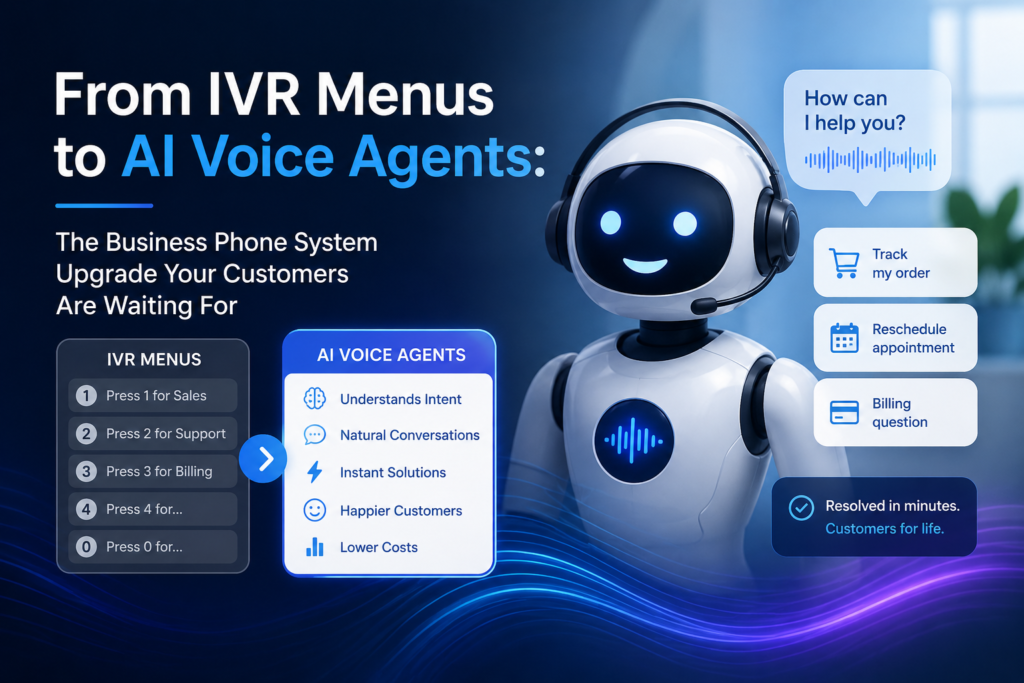
From IVR Menus to AI Voice Agents: The Business Phone System Upgrade Your Customers Are Waiting For

A customer calls during lunch hour with a simple question: “Can I reschedule my appointment?” Instead of reaching a helpful person, they hear the familiar script: “Press 1 for sales. Press 2 for support. Press 3 for billing.” They press the wrong number, wait, repeat themselves, and eventually hang up. That one missed call may not seem like much, but for a small business, it can mean a lost appointment, a missed sale, or a frustrated customer who decides to try a competitor. For years, Interactive Voice Response (IVR) menus were considered a practical way to manage business calls. They helped route customers, reduce receptionist workload, and make smaller companies sound more organized. But customer expectations have changed. People now expect fast answers, natural conversations, and support that works after hours. That is why more businesses are looking beyond traditional phone trees and upgrading to AI voice agents supported by modern VoIP phone systems and reliable business internet. Why Traditional IVR Menus Are No Longer Enough IVR systems were built for a world where automation meant fixed menus and keypad choices. They can still serve a purpose, especially for simple routing, but they often create friction when customers need help quickly. The problem is not just the technology. It is the experience. Customers do not want to decode a menu. They want to explain what they need in their own words and get routed, scheduled, answered, or escalated without repeating themselves. Recent research shows why businesses are paying attention. Gartner reported in 2026 that 91% of customer service and support leaders are under pressure from executives to implement AI. Their top priorities include improving customer satisfaction, operational efficiency, and self-service success. In other words, businesses are not adopting AI just because it is trendy. They are doing it because the old service model is struggling to keep up. What Is an AI Voice Agent? An AI voice agent is a phone-based assistant that can understand spoken language, respond naturally, and complete useful tasks during a live call. Instead of forcing callers into “Press 1” menus, an AI voice agent can ask questions like a human receptionist would: Depending on the setup, an AI voice agent can help with call routing, appointment scheduling, lead capture, FAQs, after-hours support, order updates, intake questions, and escalation to a live team member. The best systems are not designed to replace people completely. They are designed to handle routine calls, reduce hold times, and give human employees more time for complex or high-value conversations. Customers Still Want Humans, But They Also Want Speed One of the biggest mistakes businesses can make is assuming customers want an all-AI experience. They usually do not. Metrigy’s 2026 consumer research found that 84.9% of consumers still prefer a human agent over an AI agent. The same report also noted that phone remains the top way consumers interact with companies. That may sound like bad news for AI voice agents, but it actually points to the right strategy: use AI where it helps, and keep humans available where they matter most. Customers may prefer a human for emotional, complex, or sensitive situations. But they often welcome automation for practical tasks such as confirming an appointment, checking business hours, routing a call, collecting basic information, or getting a fast answer after normal office hours. This is where AI voice agents shine. They do not need to pretend to be a full replacement for your team. They need to make your phone system faster, smarter, and more available. The Real Upgrade: AI Voice Agents Plus Modern VoIP An AI voice agent is only as good as the phone and internet foundation behind it. If your business still relies on outdated phone lines, limited call routing, or unstable connectivity, adding AI will not solve the bigger issue. A modern business phone system should include: According to IBM’s 2026 contact center automation analysis, the strongest customer service strategies balance efficiency with customer experience. Automation can reduce repetitive work and speed up routine processes, but it must be designed carefully so customers feel helped, not trapped. How AI Voice Agents Help Businesses Win More Calls 1. They Answer When Your Team Cannot Many businesses lose opportunities after hours, during lunch breaks, on weekends, or when staff are busy with in-person customers. AI voice agents can answer calls 24/7, collect information, route urgent needs, and make sure callers are not left with silence or a generic voicemail box. 2. They Reduce Repetitive Interruptions Your team should not have to answer the same basic questions all day. AI voice agents can help with hours, location details, appointment availability, service areas, pricing basics, and next-step instructions. That gives employees more time to focus on customers who need personal attention. 3. They Improve Call Routing Traditional IVR routing depends on customers choosing the right menu option. AI voice agents can listen to what the caller actually says and send them to the right person, department, or workflow faster. 4. They Capture Leads Before They Disappear If someone calls for a quote, appointment, consultation, or service request, every minute matters. An AI voice agent can collect names, phone numbers, service details, urgency, and preferred callback times so your sales or support team can follow up with context. 5. They Create a More Professional First Impression Customers often judge a business by how easy it is to reach. A fast, clear, helpful phone experience can make a small business feel more established and a growing business feel more reliable. Why Reliable Business Internet Matters VoIP phone systems and AI voice agents depend on stable connectivity. If your internet drops, call quality suffers. If calls are choppy, delayed, or disconnected, customers lose trust quickly. That is why businesses should think about their phone system and internet connection together. A strong setup should support daily operations, cloud apps, payment systems, remote work, video meetings, and customer calls. For businesses that cannot afford downtime, failover internet is especially important because it helps keep

How AI Is Making Business Phone Systems Smarter — And What That Means for Your Team
AI & Business Communications

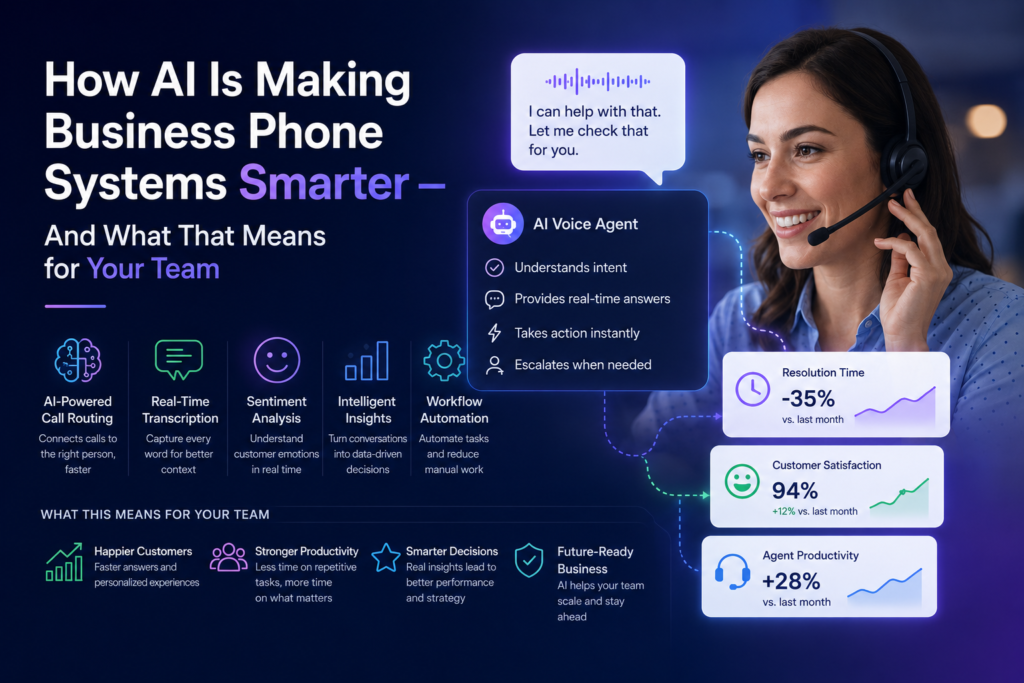
How AI Is Making Business Phone Systems Smarter — And What That Means for Your Team

In today’s fast-moving business environment, every customer interaction matters. Yet many companies still rely on traditional phone systems that simply connect calls and record voicemails. While these systems once served businesses well, they can no longer keep pace with modern customer expectations. Artificial Intelligence (AI) is changing that. AI-powered business phone systems are transforming the way organizations communicate with customers, prospects, and internal teams. From intelligent call routing to real-time call summaries and virtual voice agents, AI is turning business phone systems into powerful productivity tools. Here’s how AI is making business phone systems smarter—and what it means for your team. The Evolution of Business Phone Systems Traditional phone systems were designed to perform a basic function: connect callers to employees. Today’s AI-enhanced phone systems go much further. They can: Instead of simply managing calls, AI-powered systems actively improve communication and customer experiences. Smarter Call Routing Means Faster Resolutions One of the biggest frustrations for customers is being transferred multiple times before reaching the right person. AI-powered call routing eliminates much of this friction. Using natural language processing (NLP), AI can analyze what a caller is saying and determine their needs in real time. Instead of forcing callers through complicated menu options, the system can immediately direct them to the most qualified agent or department. Example: A customer says: “I’m calling about an issue with my recent invoice.” The AI recognizes the billing-related intent and routes the call directly to the accounting team. The result: For your team, that means less time handling misrouted calls and more time solving customer problems. AI Call Transcription Eliminates Manual Note-Taking Many employees spend valuable time documenting conversations after calls. AI-powered phone systems automatically transcribe calls in real time and create searchable records of every interaction. Benefits include: Instead of writing notes during conversations, team members can focus entirely on the customer. This leads to more productive conversations and improved service quality. Automatic Call Summaries Save Hours Every Week Beyond transcription, modern AI systems can generate concise summaries immediately after each call. Rather than reviewing lengthy recordings, employees receive a quick overview that highlights: For managers, sales teams, and support agents, this can save countless hours every month. Imagine a sales representative finishing a 30-minute discovery call and instantly receiving a detailed summary ready to be added to the CRM. No manual data entry required. AI Voice Agents Provide 24/7 Customer Support Businesses increasingly operate in a global, always-on marketplace. Customers expect answers outside traditional business hours. AI voice agents can handle routine inquiries around the clock, including: Unlike traditional automated systems, AI voice agents understand natural conversation and respond intelligently. Customers get immediate assistance, while human employees remain available for complex situations that require expertise and empathy. Real-Time Agent Assistance Improves Performance AI doesn’t just help customers—it also supports employees during live calls. Many advanced business phone systems now provide real-time coaching features that: For newer employees, this reduces training time and improves confidence. For experienced team members, it helps ensure consistency and accuracy across customer interactions. Better Insights Through Conversation Analytics Every customer conversation contains valuable business intelligence. AI can analyze thousands of calls to identify: Instead of relying on assumptions, business leaders gain data-driven insights that help improve operations, customer service, and sales performance. These insights often reveal opportunities that would otherwise remain hidden. Enhanced Customer Experiences Drive Loyalty Customers today expect fast, personalized service. AI-powered phone systems help businesses meet these expectations by: When customers can quickly reach the right person and receive efficient support, they are more likely to remain loyal and recommend your business to others. In many industries, customer experience has become a key competitive differentiator. What This Means for Your Team The biggest misconception about AI is that it replaces employees. In reality, AI-powered business phone systems are designed to support teams—not replace them. By automating repetitive tasks, AI allows employees to focus on higher-value work such as: Teams become more productive because they spend less time on administrative tasks and more time on meaningful interactions. The result is a better experience for both employees and customers. The Future of Business Communication Is AI-Powered AI is rapidly becoming a standard feature in modern business communications. Organizations that adopt AI-powered phone systems gain advantages in: As AI technology continues to evolve, business phone systems will become even more intelligent, proactive, and valuable. The companies that embrace these innovations today will be better positioned to deliver exceptional customer experiences tomorrow. Final Thoughts AI is transforming business phone systems from simple communication tools into intelligent business assistants. With capabilities like smart call routing, automatic transcription, call summaries, voice agents, and conversation analytics, businesses can improve efficiency while delivering better customer experiences. For teams, the benefits are clear: less administrative work, more productive conversations, and greater opportunities to focus on what matters most—helping customers and growing the business. The question is no longer whether AI belongs in your phone system. It’s how quickly your business can take advantage of it.

Scroll to Top